Showing posts with label SCM-Architecture. Show all posts

Monday, March 31, 2008

Software Process-Line Architecture and Common Processes

Extending the analogy of software architecture views and quality attributes for software process architecture, I'd like to spend some time discussing how software product lines relate to software process architecture and "common processes" across an enterprise.

Many organizations strive for standard common processes, often as part of a CMM/CMMI-based process improvement. All too often I have seen the mantra of "common process" misused and abused to make the practitioners serve the process instead of the other way around.
Processes don't create great software. People and Teams do!
And while the process needs to meet the needs of the business and the needs of the customer, it has to first and foremost serve the needs of the practitioners so that they in turn may better serve the needs of the business to deliver operational business value.

Many in management seem to have the mis-impression that "common process" means "no tailoring" and everyone does everything the same way across products and projects throughout the organization. Process variation across products and projects is regarded as something to eschewed and stamped out, beating the offenders into compliance with top-down dictates and mandates and sanctions. If everyone does everything the same way then the people are more or less "plug-and-play replaceable" and can quickly and easily be reallocated to another project or product with zero learning-curve and associated start-up costs.

This is a dangerous myth that causes irreparable harm to process improvement and common/standard process efforts. Anything that focuses on individuals and interactions as subservient to common processes and standard tools is doomed to fail, and those organizations often end-up with the processes they deserve (along with many disgruntled, frustrated workers).

The purpose of such common processes and tools is not to be a rigid restrictive straightjacket for replaceable people. The intended purpose is to recognize that such people are irreplaceable and to provide a flexible knowledge framework to guide and enable them as the help each other collaborate to learn, grow, and lead in the discovery, practical application and effective execution of practices and improvements that are the best fit for a particular product, product, community and business-environment.

The intended purpose common software processes is quite simply that of process and knowledge reuse! And as such it shares many of the same fundamental problems and solutions as that of software reuse. Indeed it could even be argued that software process reuse is but a special case of software reuse. And current prevailing industry wisdom on the subject suggests that software product-lines show the greatest promise of leveraging software reuse for greatest business value.

In software reuse, we seem to recognize that "one size does not fit all." We acknowledge that even though different products, components, and platforms may share common features, that each one may have different project parameters and environments with different quality attributes and engineering-tradeoffs that need to be "preferred" and optimized that particular application: dynamic versus static, performance versus memory, storage versus latency, throughput versus bandwidth, single versus multi processing, optimistic versus pessimistic concurrency, security versus availability, and on and on.

Software process reuse is no different. Different products and projects have their own uniquely differentiating value proposition (if not there would be no business-need to attempt them in the first place). And those differentiating aspects warrant many kinds of process variation across projects, products, technologies and teams.

Those coming from a SixSigma background may point out how SixSigma strives for reducing process variation. But it's all too easy to forget the context for that is when repeatably reproducing the same output from the same inputs for the same desired set of quality attributes and tradeoffs (not to mention the "kinds" of variation SigSigma is appropriate for trying to eliminate).

So I would advocate the translation and application of software product-line practices to software processes (software "Process-Lines" or "Process Families" if you will) and the treatment of such common processes as first class architectures that need to accommodate the views and perspectives of ALL their critical stakeholders, and which should identify their essential quality attributes and tradeoffs, approaches to managing commonality and variability, and apply appropriate patterns and tactics (such as modifiability tactics for software processes and projects) to meet those objectives.

In light of the above, Lean & Agile software development define an architectural style for such process families and their architecture. Lean and Agile principles identify some of the critical process-quality attributes for such efforts. And the corresponding enterprise and its product offerings and their market segments may identify additional quality attributes that needs to met (such as security, regulatory auditability/compliance, large-scale and/or distributed projects and teams, etc.)

Sunday, March 09, 2008

Software Process Architecture Views and Quality Attributes

After my previous postings on Software Architecture Views and Perspectives, Software Architecture Quality Attributes and Software Modifiability Tactics, the question remains as to what all this has to do with Agile processes or with CM.

Well, about a year ago I wrote that Software CM is NOT a Process! ...

Software CM creates the medium through which software development changes & activities must flow. Therefore, Software CM is the intentional architecture of software development change-flow.

The elements of this Software CM architecture include practices, tools & technology, teams & organizations, valued deliverables & intermediate work-products, changes to and assemblies of these deliverables & work-products, and the set of needed status/tracking reports & measures.

So now I want to take the perspective of Software CM as an architecture, and I want to consider questions like:

  • What are the views and perspectives of an SCM solution architecture?

  • How do software architecture quality attributes relate to software CM (or even process) quality attributes?

  • What are the quality attributes that, if attained, will make the resulting software CM and/or process environment Agile?

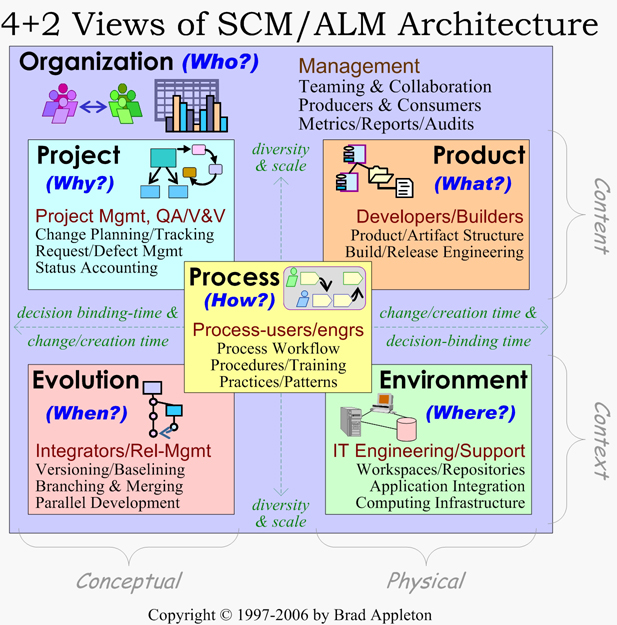
I think I answered the first of these questions in my Dimensions and Views of SCM Architecture. I take the perspective of a 4+2 views model comprising Product, Project, Evolution, Environment, Process (+1), and Enterprise (+2). These views straddle the conceptual and physical aspect of both the content and context of the different kinds of "containers" that are to be managed and interrelated. And the dimensions of SCM complexity that prove most challenging are those of scale and diversity, and of differences between artifact change/creation time and decision binding-time.

The next question involves translating what Availability, Modifiability, Performance, Security, Testability, and Usability mean for a "process" architecture. I'll make an initial stab at that (feedback is encouraged):
  • Process Availability might correspond to the availability of the underlying tools and technology that support the process. But it might also need to include both the physical and cognitive "availability" of the process itself. It probably also needs to include the availability of key information (i.e., metrics and reports) to create information radiators, and big visible charts & reports.

  • Process Modifiability is the ease with which the process itself can be adapted, extended/contracted, perhaps even "refactored", and ultimately improved. Rigid processes can't be changed very rapidly in response to a change in business need or direction.

  • Process Performance is probably what most closely translates to flow or throughput of software development. (Although for tools and the supporting computing environment, it clearly has the usual meaning there.)

  • Process Security is ... hmmn, that's a tough one! Would it mean "safety" as in keeping the practitioner safe/secure? Would it mean process quality? Or might it mean the security of the process itself in terms of making sure that only authorized/authenticated persons have access to the knowledge of the system (its requirements, designs, etc.) which may be proprietary/confidential and a significant competitive advantage, and that only those authorized individuals are allowed to execute the roles & workflows that create & modify that system knowledge? Perhaps "security" in this context is all about trust and trustworthiness: How well does the process ensure the trust and integrity of the system and of itself? How well does it foster trust among its practitioners and consumers?

  • Process Testability might correspond to the ease with which the process and its results can be tracked/reported (transparency) and audited (auditability). Perhaps it is also related to the ease with which parts of the process can be automated.

  • Process Usability probably has to do with the amount of "friction" the process imposes on the flow/throughput of development. Is it too big? too complex? a poor fit? easy to understand and execute? easy to tell if you did it correctly?


What are the "quality" attributes of an "agile" process? Do they include ALL of the above? what about: adaptive? lean? result-driven (i.e. "working software")? self-organization? iterative? collaborative?

How about some of the traditional "quality" attributes of a CM system: traceability (vs. transparency?), reproduceability? repeatability?

Saturday, May 05, 2007

Software CM is Not a Process!

The (hopefully) provocative title of today's blog-entry is inspired by Phil Armour's essay "Software is Not a Product!", which is one of many profoundly insightful essay's from his book The Laws of Software Process.

Armour maintains that:
The core issue with the business of software is that we misunderstand what software really is. Software is thought of as being a product, it is looked at as being a product, it is mostly managed as if it were a product. But it's not a product... The hard part about creating software systems is not creating them, it is in acquiring the knowledge necessary to create them (correctly).

Therefore:
    Software is not a product, it is a medium for storing executable knowledge.

Our lack of understanding of this basic fact is one of the key issues facing the software industry. We do not "build systems"—we acquire knowledge. The systems we ship to our customers are actually the byproducts of the real activity, which is to learn.

The business imperative is that the real product is the knowledge that is in the systems we ship to the customer, and we don't manage that at all.

So today, I'll attempt a similarly-themed "riff" about Software CM, beginning with the assertion that Software CM is not a process!

This assertion might seem shocking to some. Other CMers might say they have known this all along, saying CM is a discipline (rather than a process), and that numerous formal definitions of SCM have said this for quite some time: SCM is a "discipline" that "governs" or applies "technical and administrative direction and surveillance" to the functional components of CM (item identification & planning; item storage, versioning & change control; status accounting, audit & review).

If software is a medium for storing executable knowledge, and software development is a knowledge acquisition & creation (learning) activity, then the result of software CM is the medium through which software development changes and collaborative learning must ultimately flow.

If the result of software CM is a medium for the conveyance of changes by executing the knowledge gained from learning, then software CM itself must impose some form of order (structure & rhythm) to achieve this resulting collaborative flow of change-flow.

For me, terms like "order" and "structure" evoke memories from my years participating in the software patterns movement and study+discussion of the works of Christopher Alexander. For Alexander, patterns were all about discovering the innate order in structures that emerged naturally from the recurring attempt to resolve (trade-off) the same set of competings concerns (forces) for the same problem in the same/similar contexts. The resulting structures and their sequencing and interaction is what all comes together as an overall (emergent) architecture.

Hence, I would say that Software CM is an emergent yet intentional architecture that ensures the orderly, efficient flow of software development change & collaboration.

The elements of this Software CM architecture include practices, tools & technology, teams & organizations, valued deliverables & intermediate work-products, changes to and assemblies of these deliverables & work-products, and the set of needed status/tracking reports & measures.

Hmmn, this fits in rather nicely with my 4+2 Views of SCM/ALM Solution Architecture and perhaps even does a good job of tying together SCM with Agile/Lean (collaboration & flow), and software patterns (particularly SCM Patterns :).

So there you have it:
Software CM creates the medium through which software development changes & activities must flow. Therefore, Software CM is the intentional architecture of software development change-flow.

What do you think?

Friday, December 08, 2006

Dimensions and Views of SCM Architecture

The November issue of The Rational Edge has three articles that are closely related to my ideas about applying what we know about software & enterprise "architecture" to the domain of SCM/ALM solutions (and another article about an SCM tool vendor "eating their own dogfood"):


Some of you may recall my 4+2 Model Views of SCM Solution Architecture. I've since updated the picture a bit as follows (which Ive now updated over there too), click on the small image below to see a much larger one:


Anyway - reading through the above articles (particularly the one on model "dimensions" and the one on UML+RUP+Zachman together) gave me some more thoughts about my 4+2 views model, such as:

  • I have "scale & diversity" as a dimension of "concerns" that bridge all views. I wonder if that corresponds to the "scale" or "level" dimension referred to the in article on dimensions of system models?

  • I also have change/creation time, and decision binding time as a "dimension" of concerns. It's not explained real well though. I suppose it corresponds to considering both a "static" and "dynamic" perspective for each view. In a sense there are lifecycles (e.g., promotion cycles) for the elements in each view, as well as important times when decisions are committed to, and/or when artifacts or changes are made. When dealing with variation (diversity) across a product or system, the binding-time employed by the solution can be of great importance.

  • By adding a +2 view to RUP/Kruchten's original 4+1, I end up with something that sort of maps to the 6 columns of the Zachman model. Does this mean my 4+2views are really a subset of Enterprise Architecture (EA), or might it mean that its some kind of "bridge" between the two?

  • Does it really make sense for me to have Organization and data combined into a single view, or is Data really a separate view (a +3 view?), or should I not go so far as to equate metrics, queries and reports with "Data", but rather as the requirements for data (and hence the possible "bridge" mentioned above)?

  • What if I compare contrast my 4+2 views with the model or views put forth by any of ITIL, RUP-SE, DODAF, TOGAF, FEAF, or others (see below)? What value does mine add that warrants being its own "thing" instead of just some poor sawed-off wannabe clone of one of the others?

Anyways, these questiosn made me want to go look-up some of these other models and views. I found some pretty good online articles for some of them (I'm sure I missed a few as well). Here they are:


I welcome feedback/comments on any of my thoughts above!

Sunday, August 06, 2006

SCM as the Architecture of the Evolution of Architecture

One thing I particularly liked about my presentation of "SCM Patterns for Agile Architectures" at the Dr Dobbs Architecture & Design World 2006 conference in downtown Chicago...

I offered up several definitions or perspectives of SCM, including a traditional description, an Agile one, and an architectural one. I liked my architectural definition (I hadn't used that one before - I had used the other two in previous definitions). I said that, from an architectural perspective:

"Configuration Management is the Architecture of the Evolution of your Architecture!"


I rather liked that! I sort of used that to justify the title of the presentation, and presented an IEEE definition of architecture, along with Kruchten's 4+1 views model of software architecture. I then used that to justify my 4+2 model views of SCM/ALM solution architecture. I updated my drawing of the 4+2 model a bit. I think the addition of the Who+When+When+Where+Why+How shows how it may be a possible "bridge" between the Zachman Framework and the 4+1 views model.

Once again, the presentation is here. Feedback is welcome!

Friday, August 04, 2006

SCM Patterns for Agile Architectures

Back in Mid-July I gave a presentation on "SCM Patterns for Agile Architectures" at the Dr Dobbs Architecture & Design World 2006 conference in downtown Chicago.

I gave a 90 minute presentation, and I had 100 powerpoint slides. I had no intention of covering all of the slides. I had the presentation split up into an intro, plus 4 subject areas. In "Agile" fashion, I planned to do "dynamic prioritization for fixed-scope time-boxing" by polling the audience to see which sections were most interesting to them (and which patterns within which sections were of greatest interest). I figured we'd get through the introduction (which has an updated picture of my 4+2 views model of SCM/ALM architecture), and then 2 of the 4 remaining sections (3 at the very most).

I ended up making it through all of the sections and finishing on time - but I couldn't have done it without skimming quickly over the individual patterns/slides that were of least interest for my audience. Overall, I think it went pretty well. I probably wasn't animated or charismatic enough in my presentation style and should vary my tone of voice a bit more. The pictures I used were very cool and very apropos, and very well received (which is good cuz I spent a TON of time finding ones I liked that had copyrights I could use).

For those who are interested, I've made the slides available here. I welcome your feedback in improving them!

Saturday, July 22, 2006

Agile SCM Principles - Design Smells

I finally finished a set of articles I'd been working on for almost 10 years on and off on the subject of "translating" principles of OOD into principles of SCM. See the following:
In an August 2005 blog-entry on SCM Design smells, I tried to translate the design smells that Robert Martin. wrote up in his book on Agile principles, Patterns and Practices. In the first of the two articles above, I think I was much more successful at translating them into the version-control domain. Here is what I came up with ...

Symptoms of Poor Version Control
Rigidity/Inertia:
The software is difficult to integrate and deploy/upgrade because every update impacts, or is impacted by, dependencies upon other parts of the development, integration, or deployment environment

Fragility/Inconsistency:
Builds are easily “broken” because integrating new changes impacts other fixes/features/enhancements that are seemingly unrelated to the change that was just made, or changes keep disappearing/reappearing or are difficult to identify/reproduce

Immobility/Inactivity:
New fixes/features/enhancements take too long to develop because configurations and their updates take a long time to integrate/propagate or build & test.

Viscosity/Friction:
The “friction” of software process against the development flow of client-valued changes is too high because the process has an inappropriate degree of ceremony or control

Needless Complexity/Tedium:
Procedures and tasks are overly onerous and/or error-prone because of too many procedural roles/steps/artifacts, too fine-grained “micro” tracking/status-accounting, overly strict enforcement or rigid and inflexible workflow

Needless Repetition/Redundancy:
The version-control process exhibits excessive branching/merging, workspaces or baselining in order to copy the contents of files, changes and versions to maintain multiple views of the codebase.

Opacity/Incomprehensibility:
It is difficult to understand and disentangle the branching/merging and baselining schemes into a simple and transparent flow of changes for multiple tasks and features developed from multiple collaborating teams working on multiple projects from multiple locations for multiple customers

In my next entry I'll start describing the actual principles and their translations.

Sunday, December 18, 2005

4+2 Views of SCM Principles?

In my last blog-entry I wondered if the interface segregation principle (ISP) translated into something about baselines/configuration, or codelines, or workspaces, or build-management. Then I asked if it might possibly relate to all them,

Here's a somewhat scary thought (or "cool" depending on your perspective), what if the majority of Robert Martin's (Uncle Bob's) Principles of OOD each have a sensible, but different "translation" for each of the architectural views in my 4+2 Views Model of SCM/ALM Solution Architecture? (See the figure below for a quick visual refresher.)


Thus far, the SCM principles I've "mapped" from the object-oriented domain revolve around baselines and configurations, tho I did have one foray into codeline packaging. What if each "view" defined a handful of object-types that we want to minimize and manage dependencies for? And what if those principles manifested themselves differently in each of the different SCM/ALM subdomains of:
  • change control (project-view)
  • version control (evolution view)
  • artifact (requirements, models, code, tests, docs) hierarchy and build management (product view)
  • workspace/repository/site management and application integration & synchronization (environment view)
  • workflow and process design (process view)
  • teaming, inter-group coordination and interfaces/expectations (organization view)
What might the principles translate into in each of those views, and how would the interplay between those principles give rise to the patterns already captured today regarding recurring best-practices for the use of baselines, codelines, workspaces, repositories, sites, change requests & tasks, etc.

Tuesday, August 09, 2005

SCM Design Smells

First, the news of the passing of Peter Jennings (ABC World News Tonight Anchor) became known to me early this morning. I'm very saddened by this. The world has lost a great mind and communicator, and Ive lost the trusted advisor I used to let into my home every evening since I was a teen to tell me about what was going on elsewhere in the world.

Getting back to my earlier topic of The Principles of SCM, I'd like to step through each of the Object-Oriented Design Principles mentioned in Robert Martin's book Agile Software Development: Principles, Patterns, and Practices and step through each principle, looking for how it applies to SCM.

Before I do that however, I'd first like to look at what "Uncle Bob" (as he is more affectionately called) refers to as design smells. These are as follows:
  • Fragility - Changes cause the system to break easily and require other changes.
  • Immobility - Difficult to disentangle entities that can be reused in other systems.
  • Viscosity - Doing things wrong/sloppy causes more friction and slows you down the next time you navigate through that code.
  • Needless Complexity - The System contains infrastructure that has no direct benefit (overengineering and/or "gold plating").
  • Needless Repetition - Repeated structures that should have a single abstraction (Redundancy).
  • Opacity - Code is hard to understand.
How might each of these apply to your SCM process and procedures? How might they apply to your branching & merging structure? Or to the organization of your source-tree?

Here's one possible "translation" of how these might apply to Software CM process and procedures:
  • Intolerant/Fragility - Changes cause the project, team, or organization to fall apart easily and require change to other parts of the project, team, or organization.
  • Rigidity/Immobility - Difficult to identify or disentangle practices and policies that can be reused by other projects, teams, or organizations.
  • Friction/Viscosity - Doing things wrong/sloppy causes more friction and slows you down the next time you navigate through that workflow or go on to the next one.
  • Wasteful/Needless Complexity - The Process contains "waste" in the form of extra steps, processing, handoff, waiting, or intermediate artifacts that do not "add value" for the customer, project, or organization.
  • Manual Tedium/Repetition - Repeated or tedious steps and activities should have a single mechanism to automate them.
  • Opacity - The project or process is hard to understand. (Lack of Transparency)

How would you translate design smells into process smells for Software CM?

Thursday, April 28, 2005

SCM Plan or SCM Architecture?

In an earlier blog-entry I described a 4+2 Model View of SCM Solution Architecture.

Much has been written about what a CM Plan should be. If an SCM Solution is really a work of "architecture", then wouldn't an SCM Plan would actually correspond to an (initial) architectural description or "blueprint" for an SCM solution? It would have not only descriptive text, but should show models/diagrams sketching the overall strategy for each of the various 4+2 Model Views, showing the key entities and their interrelationships and dependencies.

If Martin Fowler is correct about Software Architecture as an "emergent property" (see "Is Design Dead?"), then an "Agile" SCM solution should also have emergent properties. Granted there still needs to be some amount of up-front planning and design, but some of that should also be concerned with "emergence" and how to let the architecture be adaptable, extensible, and resilient in the face of change.

And if Josh Kerievsky is correct about Refactoring to Patterns (Josh's book won the 2005 Jolt Productivity award in its category), then it should also follow that many of the SCM Patterns are simply recognition of an SCM anti-pattern that violates one or more SCM Principles, and applies an SCM refactoring to resolve the imbalance. Other SCM Patterns would be about how to successfully grow and extend a simple SCM solution whose requirements become more complex in the face of increasing scale and diversity in any or all of the 4+2 model views.

This raises some interesting (to me at least) questions:
  • Would you agree that an SCM Plan is really the initial overview or blueprint of an overall "architectural description" for your SCM solution?
  • In what ways do you think such an architecture can and should be "emergent?"
  • In what ways shouldn't it be emergent? (What and How much really needs to be planned and designed "up-front" versus emerging later "on demand"?)

Tuesday, April 05, 2005

A 4+2 Model View of SCM Solution Architecture

My interests in CM, architecture, and agility all overlap in my day-to-day work. I think the convergence is in developing what I call an "SCM Solution Architecture". Some might regard it as the SCM "component" of an overall Enterprise Architecture that includes SCM. I believe many of the principles, patterns, and practices of system architecture and software architecture apply to such an SCM solution architecture.

If we take the 4+1views approach of Rational's Unified Process (RUP), which defines the critical architectural stakeholder "views" as: logical, physical (implementation), processing (processing & parallelism), deployment, and use-cases/scenarios, and if we enhance those with one more view, that of the organization itself, then we arrive at a Zachman-like set of RUP-compatible views for an SCM solution architecture that I call a "4+2" Model View of SCM Solution Architecture.

The "4+2" Model View of SCM Solution Architecture contains 6 different views, that I characterize as follows:


  • 1. Project {Logical Change/Request Mgmt} -- e.g., change-requests, change-tasks, other CM "domain" abstractions and their inter-relationships, etc.)


  • 2. Environment {Solution Deployment Environment} -- e.g., repositories, servers/networks, workspaces, application integration


  • 3. Product {Physical/Implementation/Build} -- e.g., repository structure and organization, build-management scheme and structure/organization


  • 4. Evolution {Change-Flow and Parallelism} -- e.g., tasks, codelines, branching and merging/propagation, labeling/tagging


  • +1. Process {Contextual Scenarios/Use-cases} -- e.g., workflow, work processes, procedures and practices


  • +2. Organization {Social/People Structures} -- e.g., organizational structure for CCBs, work-groups, sites, and their interactions, and corresponding organizational metrics/reports for accounting and tracing back to the value-chain. (Mario Moreira's "SCM Implementation" book has a great chapter or two on the importance of this and some best-practices for it)


The fact that many of the views closely align with RUP suggest that UML might be a very suitable diagramming notation for modeling such an architecture. And I think that much of the current best-practices of enterprise architecture, agility,
object-oriented design principles, and service-oriented architectures apply to the creation of an agile CM environment that represents such a solution architecture.