Friday, December 08, 2006

Dimensions and Views of SCM Architecture

The November issue of The Rational Edge has three articles that are closely related to my ideas about applying what we know about software & enterprise "architecture" to the domain of SCM/ALM solutions (and another article about an SCM tool vendor "eating their own dogfood"):


Some of you may recall my 4+2 Model Views of SCM Solution Architecture. I've since updated the picture a bit as follows (which Ive now updated over there too), click on the small image below to see a much larger one:
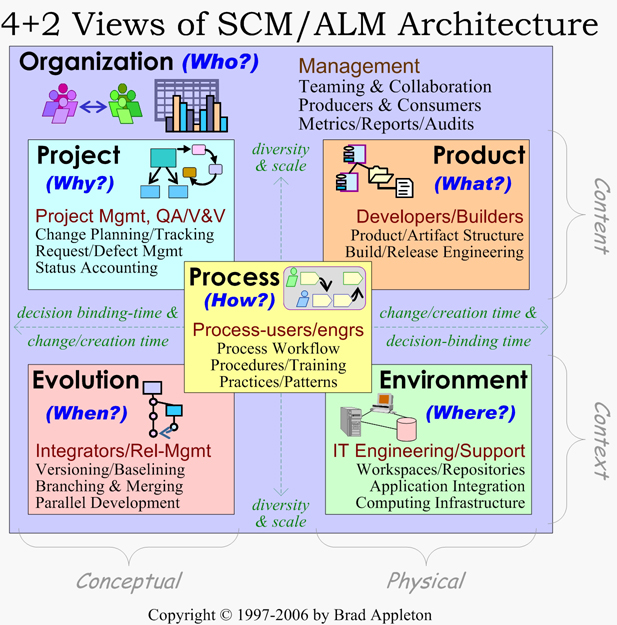


Anyway - reading through the above articles (particularly the one on model "dimensions" and the one on UML+RUP+Zachman together) gave me some more thoughts about my 4+2 views model, such as:

  • I have "scale & diversity" as a dimension of "concerns" that bridge all views. I wonder if that corresponds to the "scale" or "level" dimension referred to the in article on dimensions of system models?

  • I also have change/creation time, and decision binding time as a "dimension" of concerns. It's not explained real well though. I suppose it corresponds to considering both a "static" and "dynamic" perspective for each view. In a sense there are lifecycles (e.g., promotion cycles) for the elements in each view, as well as important times when decisions are committed to, and/or when artifacts or changes are made. When dealing with variation (diversity) across a product or system, the binding-time employed by the solution can be of great importance.

  • By adding a +2 view to RUP/Kruchten's original 4+1, I end up with something that sort of maps to the 6 columns of the Zachman model. Does this mean my 4+2views are really a subset of Enterprise Architecture (EA), or might it mean that its some kind of "bridge" between the two?

  • Does it really make sense for me to have Organization and data combined into a single view, or is Data really a separate view (a +3 view?), or should I not go so far as to equate metrics, queries and reports with "Data", but rather as the requirements for data (and hence the possible "bridge" mentioned above)?

  • What if I compare contrast my 4+2 views with the model or views put forth by any of ITIL, RUP-SE, DODAF, TOGAF, FEAF, or others (see below)? What value does mine add that warrants being its own "thing" instead of just some poor sawed-off wannabe clone of one of the others?

Anyways, these questiosn made me want to go look-up some of these other models and views. I found some pretty good online articles for some of them (I'm sure I missed a few as well). Here they are:


I welcome feedback/comments on any of my thoughts above!

Saturday, December 02, 2006

The Cone of Uncertainty

I came across a great set of responses to an IEEE Software Article by Ted Little that seemed to question the cone of uncertainty. Among the respondents were Phillipe Kruchten and Steve McConnell. This prompted me on a search for resources about the cone of uncertainty. Here is what I came up with:

Does anyone know of others? I'm particularly interested in anything available online by Barry Boehm and also from Steve McConnell. [Updated 2/2/2007 - Steve McConnell emailed me himself with the URL to a recently available article on his website]

Friday, November 24, 2006

Giving Thanks

It is the day after thanksgiving here in the U.S. Many of us have been with extended families eating obscenely large amounts of wonderfully homecooked meals and desserts and remembering what we are thankful for.

I have a LOT to be thankful for right about now. My surgery was a success and I'm still healthy. More importantly my sister is doing well with her new kidney, and we are both thankful for that, and for our children and our families (our entire family was incredibly helpful and supportive to the both of us - it's amazing to have a family like that)!

Like I said, I have a lot to be thankful for. And yet, I'm also rembering that today is a year to the day since John Vlissides passed away after a long-term battle with cancer.

John was not only co-author of THE seminal work on Design Patterns, he was also the series editor for the SCM Patterns book: he encouraged Steve and I to write it and was a mentor to us both. I would encourage folks to (re)visit the wiki-page created in John's memory.

During this time of year with the winter holidays coming, many of us give money to charities. Before John battled cancer he endured the loss of one of his own children to cancer as well, and his favorite charity was the Children's Cancer Fund (for obvious reasons). This year, I'm also a big fan of the National Kidney Foundation as well as the National Multiple Sclerosis Society (both for personal reasons).

Give Thanks! And Give Generously! :)

Saturday, November 18, 2006

The Buildmeister's Guide

I received a copy of the book The Buildmeister's Guide: How to design and implement the right software build and release process for your environment, by Kevin A. Lee, who runs www.buildmeister.com (the book is also available on Amazon.com).

I really liked Kevin's earlier book on ClearCase, Ant and CruiseControl: The Java Developer's Guide to Accelerating and Automating the Build Process. Even though it was specific to ClearCase it had a lot of really good information in general about build/release process automation. The Buildmeister's Guide "builds" on that (no pun intended) and covers build automation tools (such as CruiseControl and BuildForge) as well as Version Control in general (including tool selection and branching/merging policies). It also covers more than just Java, and has sections on other language & environment factors like .NET and C++.

All in all, it looks like a very good, and short (~110 pages) guide for beginning and intermediate build-meisters to learn a whole lot more about effective practices, resources and tools for software building and releasing.

Saturday, November 11, 2006

Simplicity in Better Software

Back in May of this year I blogged about how Simple ain't Easy: Myths and Misunderstanding about Simplicity. That entry ended up being quite popular and very well received.

This month, a streamlined version of that entry is the featured article in the "Last Word" column for the November 2006 issue of Better Software magazine. The writing is a bit more compact, though I did end up having to trim a few thoughts I had really wanted to keep. The quotations and links from the original entry didn't make it into the article, but were instead made part of the online "Sticky Notes" for the November issue.

For those with access to the printed magazine who have a chance to read both the article and the blog-entry, I'd appreciate your feedback as to whether you like the article better, or the blog-entry better, and why.

Sunday, November 05, 2006

Surviving CMMI, Lean Sigma, ISO-9000 and Surgery

My surgery went well. I returned from the hospital one week ago and am now able to get around on my own (and do some email :-). My remaining kidney is still learning to do the work of two and will be growing larger in the next couple months (in order to compensate). I'm still dealing with the usual to-be-expected-stuff and hopefully within another couple of weeks I will be mostly back to normal (except that I still need to wait another 2months before trying to lift anything >10 lbs, like my 3yr old & 4 yr old :).

I received a few more books in the mail that look like they will be very helpful to someone like myself trying to introduce/increase Agility in a large corporation that has already committed to the likes of SEI CMMI, ISO-9000 (TL9000 for Telecoms), and Six Sigma.

These books will help someone like me to "speak the lingo" when presenting Lean/Agile principles and practices to those well versed in the above. The Lean Sigma book will (I hope) especially show me how to use the methods and tools of Six Sigma itself to support Lean concepts and techniques.

Monday, October 23, 2006

Mind Hacks and Surgery

This will be my last blog-entry for at least a couple of weeks. I'm going in for surgery tomorrow to have my kidney removed and transplanted into my sister. It will take me about two weeks to recover to the point where I can sit in front of the computer for any length of time - and another two weeks before I return to work. (Well wishes and prayers for both my sister and me will be warmly welcomed :-)

I received two pretty cool books from O'Reilly the other day. They're not your normal fare. And I havent finished either of them yet. But I'm leafing through them and they both look waaaayyy cool and extremely useful:I'm looking forward to making my way through the rest of these two books and learning more about how my mind works and how to make better use of it (and better "maintain" it :)

Monday, October 16, 2006

Scaling Agility: Summary of Resources

I published a bunch of entries with numerous resources on different aspects of Scaling Agility. I wrote most of them several days apart but many of them got "pushed out" (published) together in sudden bursts. Here they are again:
Feel free to post a comment with other links are anything you feel warrants a new category (e.g., melding Agile with any of Lean, TOC, or Six Sigma)

Tuesday, October 10, 2006

Lean view of Deming's 14 Points for Management.

There has been a really great discussion thread on the Lean Development YahooGroup on the subject of "How do I find bottlenecks?"

I particularly liked a reply by Alan Shalloway that linked things back to W. Edwards Deming's 14 points for management from his Theory/System of Profound Knowledge. Allan's translation has a bit of a "Lean" slant to it, and doesn't explicitly mention eliminating/reducing variation quite so much. Here is how he summarized it:

Re respect for people, the best place to start, IMHO, is Deming. Here are his fourteen points (Chapter 2 of Out of the Crisis, by W. Edwards Deming, MIT Press, 2000; originally published in 1982.):
  1. The world has changed and managers need to adopt a new way of thinking. Delays, mistakes, defective workmanship and poor service are longer acceptable.

  2. Quit depending on inspection to find defects and start building quality into products while they are being built. Use statistical process control.

  3. Don't choose suppliers on the basis of low bids alone. Minimize total cost by establishing long term relationships with suppliers that are based on loyalty and trust.

  4. Work continually to improve the system of production and service. Improvement is not a one-time effort; every activity in the system must be continually improved to reduce waste and improve quality.

  5. Institute training. Managers should know how to do the job they supervise and be able to train workers. Managers also need training to understand the system of production.

  6. Institute leadership. The job of managers is to help people do a better job and remove barriers in the system that keep them from doing their job with pride. The greatest waste in America is failure to use the abilities of people.

  7. Drive out fear. People need to feel secure in order to do their job well. There should never be a conflict between doing what is best for the company and meeting the expectations of a person's immediate job.

  8. Break down barriers between departments. Create cross-functional teams so everyone can understand each-other's perspective. Do not undermine team cooperation by rewarding individual performance.

  9. Stop using slogans, exhortations and targets. It is the system, not the workers, that creates defects and lowers productivity. Exhortations don't change the system; that is management's responsibility.

  10. Eliminate numerical quotas for workers and numerical goals for people in management. [We add: Eliminate arbitrary deadlines for development teams.] This is management by fear. Try leadership.

  11. Eliminate barriers that rob the people of their right to pride of workmanship. Stop treating hourly workers like a commodity. Eliminate annual performance ratings for salaried workers.

  12. Encourage education and self-improvement for everyone. An educated workforce and management is the key to the future.

  13. Take action to accomplish the transformation. A top management team must lead the effort with action, not just support.

These go back 60 years. And (I can't help myself) these principles are in the context that process causes 94% of the errors - so work on the process to support the people! (people and process, people and process, people and process, ...) ;)

Alan Shalloway, CEO, Sr. Consultant
Net Objectives, Gold Level Sponsor of Agile 2006.
Integrating people, process and technology through training, coaching and consulting.


Alan's website also has some really great articles, papers, presentations and resources on Agile, Lean, Scrum, XP, Design Patterns, and all things related to Agile development and object-oriented design.

For some slightly different interpretations and summaries of Demings 14 points and Seven Deadly Sins, see the following:
There has also been a thread on another discussionlist (sorry - the name escapes me at the moment) on the relevance (or lack thereoff) of Deming's writings and philosophies in the world of today.

What are your thoughts?

Sunday, October 08, 2006

Aikidoka Leadership, Influence and Conflict Resolution

There are a few good books about conflict resolution & leadership that use Aikido style/philosophy throughout. I highly recommend them for anyone interested in the connection between leadership and martial arts philosophy:

There must be some of you out there who have some other links to share on this topic! Leave a comment with your favorites!

Wednesday, October 04, 2006

Scaling Agility: Distributed Agile Development

Current issues of IEEE Software, CACM, and ACM Queue have articles related to agile distributed development and release management ...

The Sept/Oct 2006 issue of IEEE Software is about Global Software Development. It has several Agile-related articles (like A Practical Management and Engineering Approach to Offshore Collaboration)

This months CACM theme is "Flexible and Distributed Software Processes" with articles on distributed agile development (which are currently available online), including:
ACM Queue an article on Agile/Iterative Release Management entitled Breaking the Major Release Habit.

Other resources on Distributed Agile Development:

Also, although it's not specific to Agility, the book Software without Borders appears to have some good reviews by several folks who are well-respected in the Agile community (also check out the online references section of the book.

Saturday, September 30, 2006

Scaling Agility: Agile Program Management

Over the past months I've come across a bunch of good links & papers on the topic of "Going Agile" at the program-level:

Michele Sliger (of Rally Software Development) has several good articles and presentations on Relating PMBOK Practices to Agile Practices
On using Agile methods in organizations with a stage/gate approach to program management, see some of Per Runeson's work in this area:
Murray Cantor has some good papers on Governance and Variance as it applies to Agility:
Some other papers & resources:

Those interested in some advanced agile planning concepts should look at Jeff Sutherland's paper on Scrum II - The Future of Scrum: Parallel Pipelining of Sprints in Complex Projects (and the presentation slides that go with it)

There are several REALLY GOOD whitepapers on Adopting & Scaling Agile at Rally's Agile Knowledge Portal, including the following in particular:

There's gotta be some other good stuff out there and Agile Portfolio, Program and Multi-Project Management! If you know of any - please add a comment and hyperlink or URL!

Thursday, September 28, 2006

Scaling Agility: Agile Systems Engineering

Over the past months I've come across a bunch of good links & papers on the topic of "Going Agile" at the program-level for large systems and systems of systems. Some of these relate to Agile program Management and others are more about Agile Systems Engineering (and some relate to both). I'll mention the ones on Agile Systems Engineering in this blog-entry and leave the ones on agile program management for a subsequent entry:


That's the best I came up with. If you know of other good links on this topic, please send me a comment!

Tuesday, September 26, 2006

Scaling Agility: Adapting Agile to the Organization

Here is a list of resources I've found that I feel are applicable in figuring out how to scale Agility for a large organization and project. (On the subject of metrics and values, I personally find Sam Guckenheimers work to be of greatest interest):


Additions and corrections are welcome!

Thursday, September 21, 2006

Scaling Agility: Seamless Agility across the Enterprise

David Anderson writes about the recent Agile2006 conference in his blog-entry Thoughts for Agile2006:

Scaling Agile. The BIG issue for this year is scaling agile across a whole organization. I see this as having three parts - program or multi-project management and the rollup of schedules and resource plans to a Director or VP level; architecture and enterprise level modeling of a domain and data center; and finally configuration management including build, integration, branch and merge strategies, and work-in-progress batching and related communication.

Ive been dealing with this topic a LOT lately in my own organization as part of efforts to spread amd adapt Agile methods across a large distributed enterprise working with large systems and teams. Ive been researching and collecting lots of resources, including some earlier blog-entries on Agile CMMI and Dancing Elephants and Agile Adoption across the industry.

My perceptions of where the "seams" of the enterprise are that are hardest to introduce Agility into are the close collaboration and alignment required across organizational (lifecycle discipline) boundaries and geographic boundaries (and I find the former to be more difficult to surmount than the latter.)

If I try to categorize them as different areas or aspects that each require the ability to be agile, I come up with something like:
  • Process - Adapting Agile to the Organization (making processes responsive to change)

  • Product - Agile Systems Engineering/Architecture (making the requirements & architecture be responsive to change)

  • Project - Agile Program Management & Governance (making the project be responsive to change)

  • People - Distributed Agile Development (collaborating across multiple sites, teams, and timezones)

  • Organization - Agile Metrics/Reporting, Governance, and Organizational Design

  • Environment - Agile CM, deployment, operation/support, etc.

I'll be blogging separately with lists of resources of found for several of the above.

Monday, September 18, 2006

TEA-Time - a metric to elicit TDD behavior?

I've been thinking about a metric that might elicit Test-Driven behaviors in my organization. As a first step to TDD, we definitely want folks to create automated tests as much as feasible and execute them frequently. Once they get that, I've been thinking about what sort of metric might encourage them to actually work in short, test-driven cycles, where requirements are elaborated test-by-test (given a use-case or story, write the first test, write the code to pass the test, refactor, rinse-lather-repeat).

Some of these folks are very much ingrained in a systems engineering V-model lifecycle that does a lot of big-requirements up-front. So ensuring they work to automate tests and execute them frequently isn't enough to enourage them to use an interative approach of fine-grained TDD-style elaboration. An idea I had for what to measure is something I chose to call Test-Execution Availability Time, or TEA-Time (I figure if nothing else, my friends in the U.K will like the name :-).

As proposed, Test-Execution Availability Time (or TEA-Time) would be defined as the mean time between when a system requirement description is first baselined, and the time at which a "sufficient" number of automated tests for the requirement were implemented and ready (available) to be executed.

I was thinking that if a group was measuring this and wanted to behave in a way that minimized TEA-Time, it might encourage them to elaborate requirements in an iterative and incremental fashion, in smaller and smaller "functional slices". One thing I'm not sure of is what "a sufficient number of automated tests" should be in the above.

Any thoughts or comments?

Friday, September 15, 2006

REVIEW: Practices of an Agile Developer

Are you a developer who wants to improve your personal development habits in a way that helps not just yourself, but also incrementally improves your project and your team? If so, then run, don't walk, and get your hands on Practices of an Agile Developer: Working in the Real World by Venkat Subramaniam & Andy Hunt, from the Pragmatic Programmer's Bookshelf.

Want to know more about why? Then read the complete review in the September issue of The Agile Journal (the theme for September is Collaboration and Reuse).

Tuesday, September 12, 2006

Agile CM on YahooGroups

As mentioned in an earlier blog-entry, I have created an Agile CM Yahoo Group. The description is:
The agile-cm group is for the discussion of ideas relating to Configuration Management for Agile development and of applying Agile concepts, methods and tools to the practice of Configuration Management itself (and CM "Patterns"). This includes aspects of CM that relate to agile development, refactoring & design patterns, agile project-management, Lean, Theory of Constraints (TOC), even SixSigma and CMMI to the extent that they can help CM and related practices to be more "agile".

As I wrote earlier, I hope this new agile-cm group will have a healthy balance of both SCM folks and Agile development folks so we can have some constructive multi-faceted discussions.

Saturday, September 09, 2006

How I Blogged my Summer Vacation

Some of you may have wondered what the heck happened to my blog during August and the first half of September. Well - I lost some write-access to my website for a lot of the summer (while my host was recovering from a denial of service attack) and I couldn't login and update it.

I had several blog-entries "queued up" simply needing some final cleaning-up before I made them live, and that got interrupted, then I couldnt access them, then I had some vacations/travel, then I needed to "catch up" when I got back to work, and so on ...

So over the next week or two I'll be "pushing out" the entries I wrote-up in August, using the date they were originally written. I'll also be making available the talk I gave in July at Architecture & Design World 2006 on the subject of "SCM Patterns for Agile Architectures."

In October/November I may not be blogging much at all as I'll be trying to recover from major surgery (I'm giving one of my kidney's to a family member).

Monday, September 04, 2006

Relating SCM Patterns to SCM Principles

Our August Agile SCM column in the CM Journal is about Relating SCM Patterns to SCM Principles. The article is pretty flimsy, barely a skeleton, and that's pretty much entirely my my fault. I meant to write more "meat" about how certain principles are the underlying forces behind several patterns. I wanted to show how the principles are strongly related, much the same way patterns in a pattern language are related. And I wanted to show how that structure shaped the relationships between the patterns as well. Rob did a really good job trying to put together what I had with what he could come up with, but I didn't really give him enough and couldn't easily convey it in a way that made it easy for him to "run with it!"

It's not that I don't see those relationships, I do. And I'm not lacking for words to describe them either. I'm having trouble describing them clearly and concisely. A big part of that is because I still don't like the names of the SCM Principles as I've described them so far. Their names currently relate to the OOD Principles they were derived from. I think that might speak to programmers, but not to folks trying to do version control (even if they also wear "developer" hats). I really want to go back and rework the names of the principles to be more simple and direct.

This is something Ive been working in my mind on and off for alkmost a decade now. To me, it is of profound important - perhaps even the most significant contribution I'll have made to the field of SCM to date. THe interest level doesn't seem to be so high on the scm-patterns list and the cmcrossroads.com forums (but that hasn't deterred me - yet :). I really do think it's not a coincidence that principles of object-oriented design also manifest themselves as fundamental principles of SCM solution design (because I think both are all about architecture - and minimizing and managing dependencies).

I'd really like feedback. On this stuff so if you've had a chance to read thru the June, July and August Agile CM columns, I'm going to create a new YahooGroup about Agile-CM for discussing these and other Agile CM issues. Hopefully this new agile-cm group will have a healthy balance of both SCM folks and Agile development folks so we can have some constructive multi-faceted discussions.